
 Content Team
STEM education at an early age is vital to preparing students for the modern world. It can shape how kids get interested in dynamic career paths and promote more diverse and constructive interests. But STEM education prioritizes more than just teaching science, technology, engineering, and math. Despite the historical teaching of these subjects, STEM education promotes methods that enhance student engagement in the learning process. Implementing these subjects in K-12 learning necessitates the use of engagement methods. Here are some ways to boost engagement in STEM education.
Hands-on Learning in STEM Education
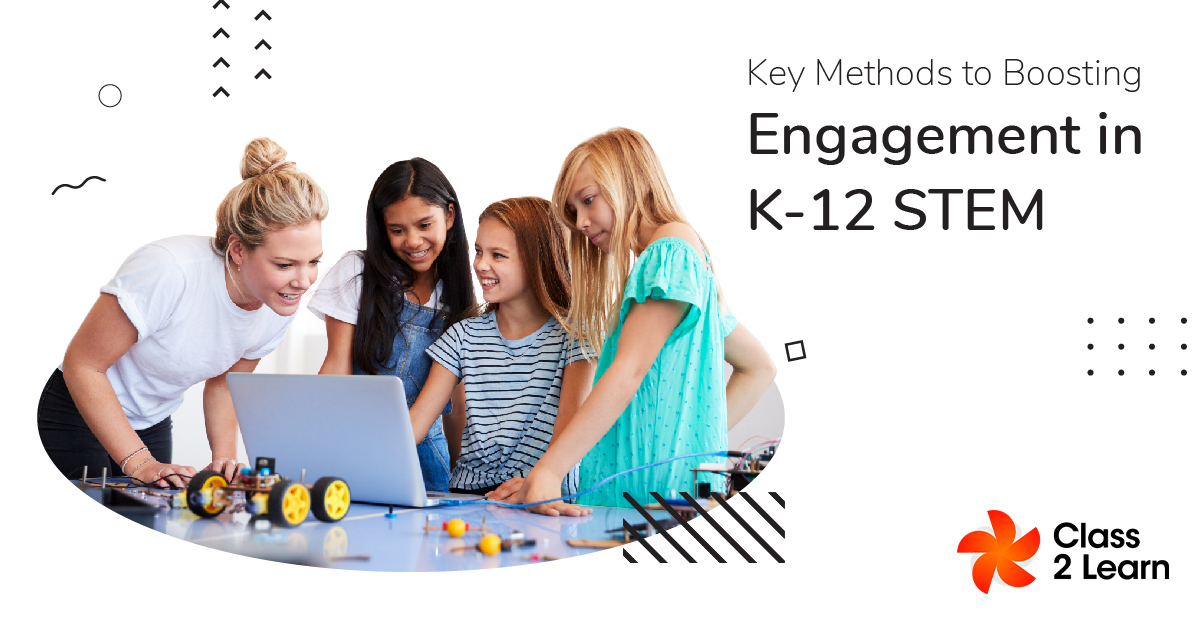
STEM stands out because of its emphasis on hands-on learning. Students are taught how to conduct their science experiments, work on projects, and construct things. As a result, students are interested and invested in their studies. Hands-on projects have several advantages: they connect the lesson to real-world applications, they provide students a sense of success by providing a physical product of their classwork, and they allow students to work independently and find their solutions rather than relying on a book. These advantages will help youngsters retain knowledge, motivate them to be more engaged in these areas in college and beyond, and provide them with the tools they need to construct their projects. Research shows that changes in cognitive skills in kids aged 6–10 significantly influence how effectively they engage in hands-on learning.
Give pupils control over the tools they will utilize
STEM’s emphasis on hands-on projects may make it useful to familiarize kids with the tools they’ll use. Allowing people to design, control, or alter the tools themselves can help them become more invested in their job. They can walk away from their STEM projects with a concrete outcome, such as a measuring or construction tool, a coding environment or IDE for programming, or a cheat sheet for arithmetic or computer science. Giving students these materials allows them to continue working on their projects rather than just leaving them with the finished output.
Incorporating Human Stories into STEM Learning
If STEM subjects lack personality and relatability, adding lessons that concern real people and their achievements can help. STEM thrives on real-life connections, encompassing more than just the objects that science and technology can create. Some students may not relate to STEM’s abstract ideas, but they can connect with its achievers. Incorporate lessons about famous scientists and inventors and why they became interested in scientific fields so students can have the same realization and relate to them. When possible, recreate famous experiments and achievements performed by people like Galileo, Newton, and Einstein.
Encourage creativity and independence
Especially in their teenage years, students are trying to express themselves and become independent from their parents. STEM educators can tap into this by allowing students to have more say in their education and make meaningful choices. Letting them choose project subjects in STEM classes is one way to accomplish this. STEM encourages hands-on projects that are much more adaptable and creative than textbook- and test-based assessments. More creativity will boost engagement and enjoyment from students.
Reward teamwork and communication
Working in groups helps kids learn to exchange knowledge, solve issues, and improve their social skills. These abilities are critical for kids pursuing STEM professions. It’s also an excellent technique to increase student involvement in a class by making them work hard to defend their decisions to others and achieve a solution. This will also teach kids to appreciate tasks that cannot be completed by one person alone and require cooperation, which will motivate them to seek out on their own to establish project teams and organizations. Helping your child collaborate better starts with building strong research and communication skills read more about how students can find trustworthy research sources.

Add comment